Somebody has to pay for the server
Somebody has to pay for the server
Free-to-play is not a discount on a product — it is a different theory of who pays, how much, and when.
The accounting that makes zero work
Every persistent online game runs on rented compute, licensed middleware, and a live operations team that patches and monitors around the clock. None of that is free. What is free, in the free-to-play model, is acquisition — the moment a player downloads the client and logs in for the first time. The cost of that moment is zero to the player and close to zero to the studio, compared with the alternative: buying shelf space, manufacturing discs, and convincing a retailer to stock a boxed product. The old retail model bundled the server cost into the purchase price and called it done. Free-to-play unbundles everything, charges nothing up front, and recovers costs from behavior rather than from a transaction.
The mechanism that makes this solvent is the distribution of spending across a population. In a healthy free-to-play title, the overwhelming majority of registered players never spend a single currency unit. Industry analysis has consistently found that somewhere between one and five percent of active users account for the bulk of revenue — a finding that has held across mobile, browser, and client-based PC games for well over a decade. These high-spending players are often called whales in studio shorthand, a term that is purely descriptive of spending behavior and carries no design implication on its own. The model is not designed for whales specifically; it is designed so that a product can be viable even when most of its users cost more to serve than they generate.
That cost — serving non-paying players — is not waste. It is the product's social infrastructure. Non-paying players provide the environment that makes the game worth paying for: they fill markets, fight battles, trade goods, and populate the world that paying players inhabit. The free tier is a feature of the design, not a concession to it.
A massively multiplayer game with no population is not a game; it is an empty server.
What is actually being sold
The thing being sold is not the game. It is time, status, and reduced friction — three categories that map to almost every monetisation device the industry has developed.
Time-saving purchases let players skip grind. In a game where a resource takes forty hours of play to accumulate, a direct purchase collapses that to a second of checkout. The game must be designed with enough grind that the purchase is tempting, but not so much that non-buyers abandon the product entirely — a calibration that live-operations teams adjust continuously through data. The server-side economy of a persistent world is not static; studios track spending rates, conversion rates, and player retention against each other, nudging prices and drop rates in response.
A cosmetic item available only during a limited window, a character skin that signals participation in a particular season, a title or border that marks an account's age — these are pure scarcity goods whose value is social rather than functional. Because they do not affect game balance, they are generally considered the cleanest form of free-to-play revenue, and they are the foundation of the battle pass model that became dominant in the late 2010s: a time-boxed reward track that converts consistent engagement into a sequence of purchase decisions.
Status purchases sell differentiation that cannot be earned by play at all.
Reduced-friction purchases cover everything else: inventory slots, additional character slots, accelerated crafting queues, premium currency that bypasses the in-game exchange rate. These occupy the awkward middle ground because they can shade into pay-to-win if the friction being removed is competitive rather than merely inconvenient. The distinction matters to player communities — and increasingly to regulators — because a game that sells power rather than convenience is a different product from one that sells cosmetics.
Gacha — a randomised draw mechanic named after the Japanese vending-machine capsule toy — sits in a separate category because it introduces probability and variable reward into the transaction. Probability disclosure requirements now exist in several jurisdictions; South Korea was among the first markets to mandate that developers publish the odds of each outcome in a randomised box or draw. The regulatory pressure reflects a genuine design tension: variable-ratio reward schedules are among the most effective mechanisms known for sustaining engagement, and a monetised version of that schedule is something legislators in multiple countries have examined under consumer-protection frameworks.
The invoice beneath the invoice
Free-to-play did not invent the server cost; it made that cost visible as a continuous obligation rather than a one-time capital question. A boxed game that shipped with a server component could, in principle, shut the servers when the sales stopped. A free-to-play game with a persistent world cannot do that cleanly — the world is the product, and closing it is the end of the product, not a business-as-usual decision. The sunset of a live service game destroys something that exists nowhere else: characters, economies, and social histories that were built inside that specific running process and exist only as long as it runs.
This is why the economics of the model carry consequences beyond accounting. When a studio commits to a free-to-play persistent world, it is also committing to keep a server running for as long as the population is large enough to be worth serving — and to make a decision, eventually, about when it is not. The calculation is not entirely cynical: maintaining a server that costs more to run than it earns is not sustainable for any organization. But the asymmetry between what players invest — years of time, real money, community relationships — and what they legally own — a license to access a service, revocable — has been a consistent source of tension since the model became the industry default.
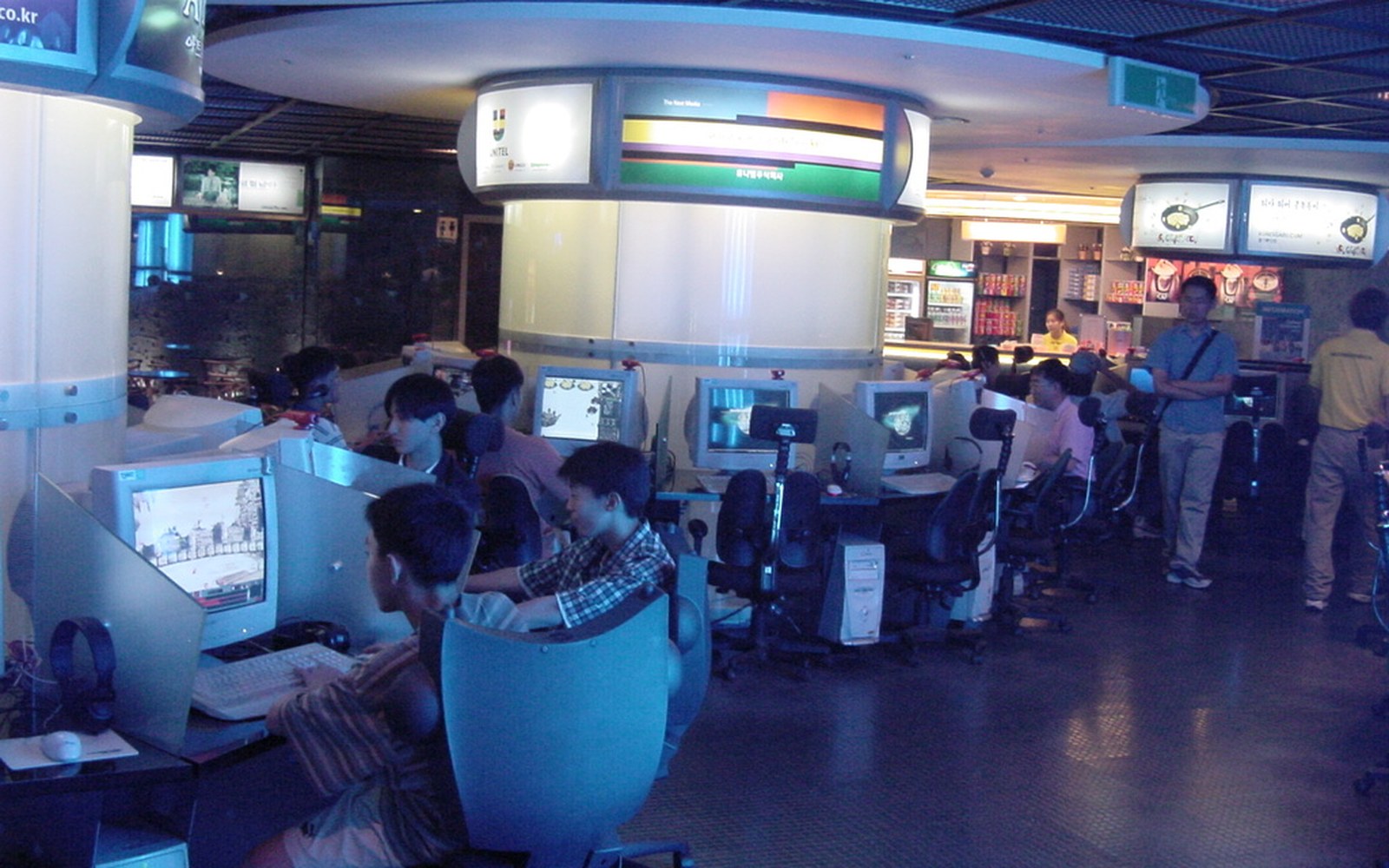
The origin of the model as a commercial mainstream is closely tied to the particular conditions of South Korea in the late 1990s and early 2000s: dense broadband penetration, a PC-café culture that made per-session access normal, and a market where charging a monthly subscription was harder than charging for items. What emerged there — a model built on optional purchases rather than access fees — proved exportable precisely because it lowered the barrier to entry to zero. A game that costs nothing to try can reach an audience that a game with a box price cannot.
The result, across two decades, is that free-to-play has become the default rather than the exception in online games. Understanding what sustains a virtual economy — how currencies inflate, how sinks absorb excess, how faucets inject supply — is now inseparable from understanding how the product pays for itself. The accounting is more complex than a cover price, and less transparent to the player experiencing it. But the server does not run on goodwill. Someone, somewhere in the active population, is paying for the electricity, the bandwidth, and the team watching the dashboards at three in the morning. The model's elegance is that neither side needs to know exactly who.
Read next
Elsewhere on the site