Somebody has to pay for the server
The Korean invoice
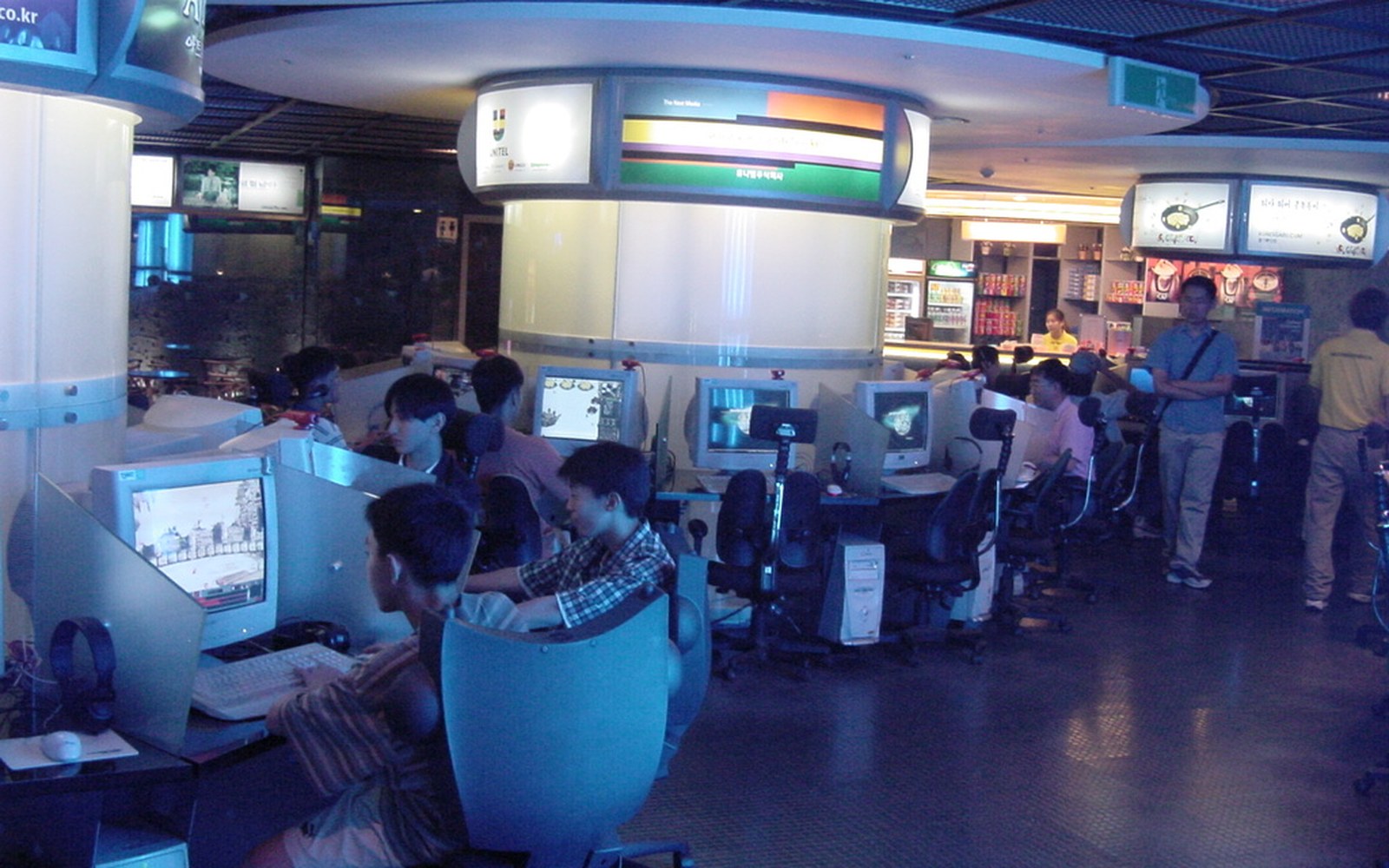
South Korea's PC-café economy made the subscription model impossible before it ever took hold — and the industry has been living with the solution ever since.
The infrastructure problem that invented a business model
In the late 1990s, South Korea built one of the world's most dense broadband networks faster than almost any other country, a rollout driven partly by government policy and partly by intense urban concentration. The result was a gaming culture that did not map onto anything Western publishers had assumed. Players did not sit in private bedrooms with their own machines and their own monthly credit-card bills. They sat in PC bangs — the Korean term for commercial gaming parlours — paying by the hour for a seat, a fast connection, and access to whatever was installed on the house machines. By the early 2000s, tens of thousands of these venues were operating across the country, many of them open around the clock.
That physical fact destroyed the subscription model before it could establish itself. A subscription, by design, charges one account for one player's access. In a PC bang, the seat changes hands every hour. A single account might be used by six different people in a single day, none of whom share a household or a payment method. To charge a monthly fee in that environment was to charge nobody, because the person at the keyboard had no incentive to maintain a personal subscription to a game they would play for ninety minutes on a stranger's machine. Publishers faced a choice: find a way to charge the venue, or find a way to charge the session.
Instead of charging for access at all, they made access free and charged for items — cosmetics, convenience goods, temporary boosts, equipment that could not be earned through play alone. The logic was clean: a player who sat down at a PC bang, loaded a free game, and spent two hours inside it was a potential customer for a purchase that cost less than the hourly seat fee. Lower the friction of the transaction to something a player would not think twice about, and enough of them would buy that the game sustained itself without a single subscription.
Most chose neither of those, and the solution they landed on was more elegant than either.
The games that carried the model west
The market that embraced this architecture was built on serious games, not casual experiments. Lineage, developed by NCSoft and launched in 1998, was a fully realised massively multiplayer world with a persistent economy, guild warfare, and a player base that at its peak was a significant fraction of South Korea's adult population. Its sequel, Lineage II, reached international markets in 2004. MapleStory, from Nexon, launched in 2003 and spread through Southeast Asia and then North America by mid-decade, carrying the free-to-play item-shop model with it. Nexon in particular became the company most closely associated with formalising that model as an exportable product: its internal design language treated the item shop not as an afterthought bolted onto a subscription game but as the core revenue layer around which the rest of the design was built.
What those games demonstrated, and what Western developers were slow to accept, was that free-to-play is not a discount but a different accounting: acquisition costs nothing and revenue is captured post-engagement. A player who has invested forty hours in a character before spending a single dollar is a different kind of customer from one who pays upfront and may or may not return. The emotional stakes are higher, the attachment is real, and the purchase, when it comes, is made in a context of genuine desire rather than speculative subscription.
The item shop also had an advantage that subscriptions lacked entirely: it scaled with desire rather than time. That asymmetry is the engine of what is now called the whale dynamic, a term that became industry standard, in which a small fraction of the player base accounts for a disproportionate share of revenue. The design implication is that the game must be good enough to sustain a large base of non-paying players — because those players provide the social world that makes the paying players want to be there.
A player who loved the game could spend far more than any monthly fee; a player who was casual or uncertain spent nothing.
Gacha, regulation, and the cost of the model
The Korean export did not stop at simple item shops. Alongside cosmetics and convenience goods, a second mechanism arrived: the randomised draw, known in its Japanese variant as gacha — named after the coin-operated capsule-toy vending machines common across East Asia. In a gacha system, the player purchases not a specific item but a chance at one, with probabilities that the operator sets and that historically were not disclosed. The draw mechanic exploits the same psychological architecture as a slot machine, which is precisely why it attracted regulatory attention.
South Korea was among the first jurisdictions to act. Its Game Rating and Administration Committee began requiring probability disclosure for randomised items in 2015, and the rules were tightened further in subsequent years. Belgium and the Netherlands moved to classify certain loot-box implementations as gambling under existing law, which forced publishers operating there to publish the odds or withdraw the mechanic entirely. China required probability disclosure from 2017. The direction of travel across most major markets has been toward transparency, though the specific legal status of randomised item draws remains contested and jurisdiction-dependent.
The battle pass, which became the dominant alternative mechanic after Fortnite popularised it in 2018, was partly a response to that regulatory pressure and partly an independent design discovery. It charges a fixed fee for a time-limited reward track — progress through which is earned by play — and discloses exactly what is available before the player spends anything. The purchase decision is made with full information, which neatly sidesteps the probability-disclosure problem while preserving the time-pressure dynamic that drives conversion.
What the invoice actually looks like
Trace any major free-to-play game's revenue back far enough and the lineage is legible. The terminology is different — the item shop is now the storefront, the PC bang has been replaced by the home broadband connection that South Korea also helped normalise — but the accounting structure is the same one that NCSoft and Nexon exported from Seoul in the early 2000s. Access is free. The world is persistent, which means it runs as a cost with no natural end. Revenue comes from a fraction of the players, at transaction sizes that range from a few dollars to sums that would have bought several months of any subscription.
The PC-bang economy was a constraint that looked, at the time, like a problem specific to one country's unusual infrastructure. What it produced was a business model that now funds most of the online gaming industry worldwide — designed not by a strategic planning committee but by the practical necessity of charging people who shared machines in a country that had very good broadband very early.
Read next
Elsewhere on the site